
ANIMAL PRINTS at Chris Thompson Memorial Preserve
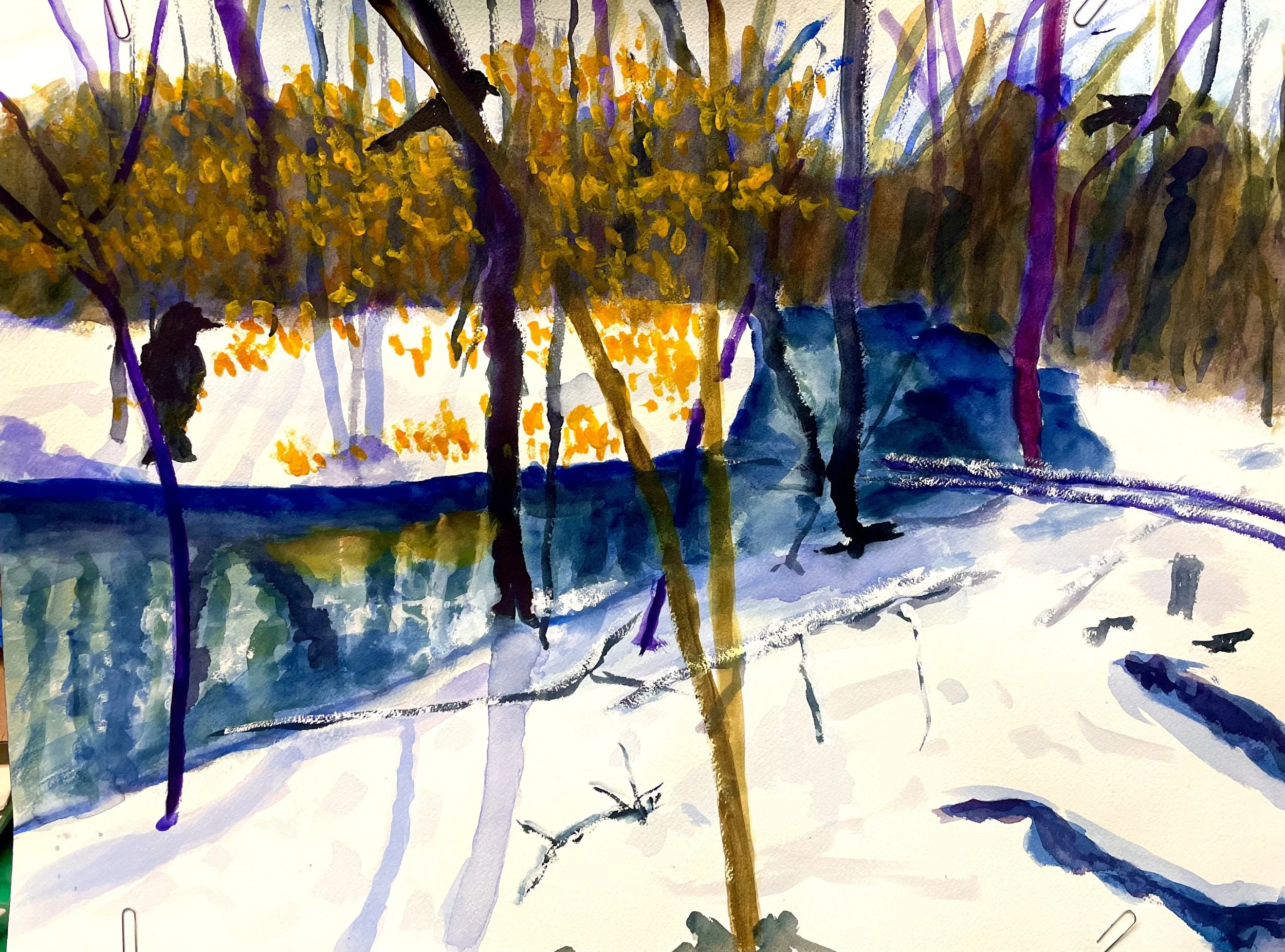
Art by HCH Member Ed Ravine, inspired by the Riverside Loop at Chris Thompson Memorial Preserve.
We have hiked over dunes, near lakes and rivers, in forests and nature preserves. Our fearless leader, Pat Fisher, has explained landscape formation, geology, the seasonal budding of wildflowers, invasives, and the creatures who live under dead trees and inside the mud of vernal pools (just to name a few things). We have learned about winter layering and summer spraying, so it may well be that on January 17th we were doing what we had done one time or another, but it felt new. Pat pointed out prints that had been left in the snow. These specific markings gave hints as to what creature had been close to us and even what that creature might have been doing.
Before that happened, though, we gathered in the parking lot. We were a hugely bundled group. The weather hovered around 18 degrees Fahrenheit. We initially numbered around 9 strong, hardy individuals and expanded to 25 that included parents and children who weren’t part of the group, but who tagged along to learn about animal tracks. One young boy made tracks with a stick to add to the others. We were given two sheets. One showed the animal tracks of Michigan forest and field animals and Michigan wet area animals. Environment immediately gives a clue as to what animal has left prints. The other sheet was a guide on how to identify tracks and the stories that they tell.
Tracks can tell if an animal is sitting or standing, playing or eating, where that animal has been and is going. Tracks indicate the basic anatomy of animals: how they move, if they hop, gallop, walk in a straight line, and what they are looking for. While the dog goes everywhere, including away from owners, the muskrat and beaver make their homes near water; the deer frequent forest and field. The coyote, out in the wild and, I suspect in urban and rural areas, unlike the dog, doesn’t circle around in energetic play. Conserving energy, the coyote makes straight tracks with the intention of getting a meal. Domestic dogs have a good meal in a warm house. There is no need for conservation.
The kind of prints an animal leaves also point to species. The dog, the coyote, and the bobcat all have padded feet, but the bobcat’s tracks don’t reveal claws. The cat has an amazing ability to retract and extend claws. Moving in silence, the cat walks with sheathed claws. One never hears clicking. The almost perfectly straight deer prints look like two horizontal lines. Deer plant their hind foot in the place just made by the front foot. This also conserves energy.
We followed the path around the Galien River and explored the habitat: the sycamore trees that like water, the blue beech, and the black cherry trees. As in the fields, we saw the tracks of squirrels. Like rabbits, hares and mice, the squirrels seem to leapfrog. They touch down with their front feet and then bring their back legs in front of the forefeet.
Peering down at chewed, fallen branches and winter seed droppings, we learned that leftover food like hickory nuts reveal what rodent had been gnawing and, in the process, filing down continually growing teeth. Our poles made tiny, pointed indentations in the snow. We were leaving our own tracks. A scout could tell if the shoe most probably belonged to a woman or man, could identify the make of the shoe by the tread, the weight of the person by how deep the tracks were and how energetic the person was. The tracker could identify the number of people and speculate on age. We left a lot of clues.
Pat had previously mentioned that bears aren’t true hibernators. They will wake in the winter and even give birth typically around January. We also learned that woodchucks or groundhogs, some chipmunks, 13-lined ground squirrels, woodland/meadow jumping mice, and various bats are hibernators which enter deep sleeps for months on end.
The trail near the river is a couple of years old and makes for interesting walking. We were told how important it is to allow leaves to stay on the ground throughout the winter. Leaves are insulators for trees. Tree frogs freeze under leaves, and some beneficial pollinators like native bees and butterflies leave overwintering eggs under leaves. We noted a disturbed leaf pile, called that because an animal had looked through it for food.
Carefully, the group ascended, the small, icy hill back to the old field being restored to a native prairie. I have just read that there is a pollinator garden that was installed in 2022 near the parking lot. Visitors can see native species up close. That would be a nice thing to do after a hike. It would also be nice to hike in the spring when the mud makes for great print identification.
Back in the lot we learned that Chikaming Open Lands dedicated the Preserve in memory of their late executive director, Chris Thompson. More about him and the 49-acre area is described on the Chikaming Open Land website.
Sometimes winter seems so long and cold, particularly this winter. Winter hikes make beautiful tracks in our minds that we can mull over as we drink tea or coffee and spend yet another day clearing snow from our driveways.
We’ll be posting some pics from that hike on Facebook at <FB.com/HarborCountryHikers>.
Graciously Contributed by Miriam Bat-Ami