
OUR UNIQUE BERRIEN COUNTY
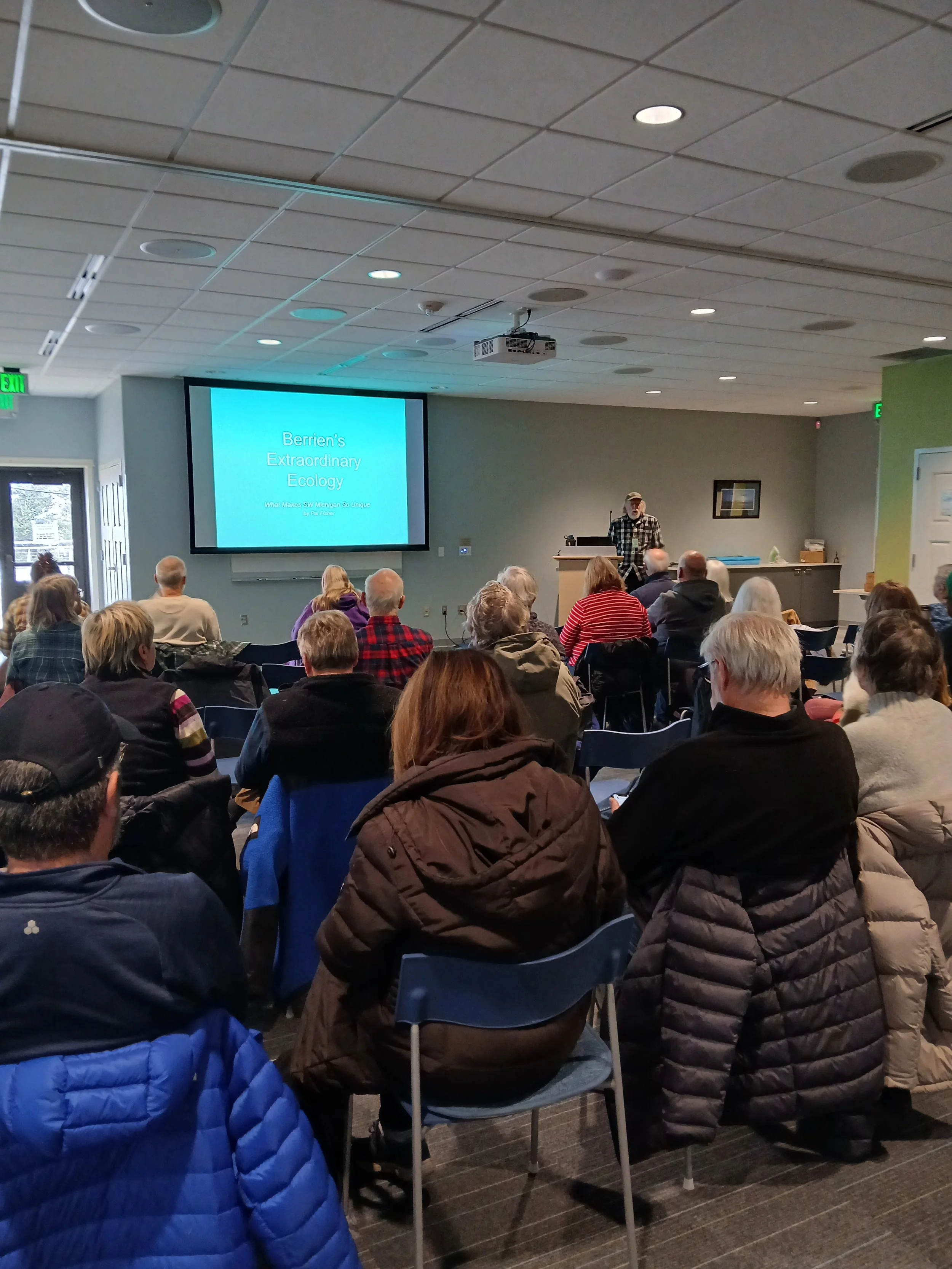
Pic by Member Miriam Bat-Ami
We were not outside digging our walking sticks into the snow. We were not bundled in our winter coats, wearing mittens or gloves, and a warm hat. Still, we traveled around Southwest Michigan through the slides and the presentation that our Harbor Country Hikers’ president, Pat Fisher, gave at the New Buffalo Township Library. We traveled in distance and time to discover how unique Berrien County is. There were at least fifty people in attendance, fifty curious people many of whom asked questions and got answers from a man who introduced himself as “self-taught,” and who has not merely taught himself but continues to teach others.
Pat began by saying that what he would present could pass as a college course lab on spatial ecology or an investigation on how the interaction of organisms and habitats, affected each other on our glaical landscape. When one element disappears or appears, often as an invasive, there is a much larger effect. Native plants lose space. The insect that thrives off that plant has no food. The bird that eats the insect has no food. The food chain is disrupted.
And there have been great disruptions. We learned how 400 million years ago Michigan sat under water at the equator. Hard to think of Michigan as an equatorial state particularly in the middle of February. In salty water whales and sharks swam. Toward the close of the Ice Age, with the soil and rocks below, soft, glaciers easy carved their way through Michigan and left behind what Pat affectionately termed “glacier poo.” Fun Fact: 99% of our SW Michigan glacial remains is stuff from Canada and the Upper Peninsula. Our moraines are glacial poop. Our kettles are blocks of ice that broke off and became pooled indentations. The remains of glacier movement gave Berrien County its unique quality. Mt Tabor Trails has plants we don’t see near the shores. The Baroda of the 1800s was a swamp filled with sediments from proglacial lakes and drainage ways, and then there are the unique dunes dependent on shifting winds and vegetation whose root system holds down sand. Another contributor to Berrien’s unique biodiversity comes from the blend of ecotones conjured from the confluence of terrestrial and aquatic biomes that meet in our little corner of Michigan, defined by their unique climate, soil, plants, and animal life.
Pat spoke about succession: the oak and hickory trees of 11,000 years ago and the beech and sugar maple that came later. He spoke about disappearances that, like invasives, were brought about because of human interference: introducing into the native population what shouldn’t be introduced and dismantling what should remain: the great fire of Chicago that spread across Michigan and laid waste to land, the logging that made forests into flat fields. I cannot point to the ills of our having worms, but, as Pat pointed out, these slow-moving creatures could not have gotten here by themselves. Fisherman had to bring them. Score one small point for worms in Michigan.
Added to the beneficial addition of the worms, are white pine which shouldn’t be here except for our temperate climate, the lake and the breezes coming off it. Also unique are the jack pine, and the hemlock. In our region alone there are 40 species of plants typical of the Atlantic and Gulf Coast. When I walk the dunes, I’m always amazed by the cacti and was gifted one for my front yard (not taken from the dunes). That it survives the winter and, every so often during the summer, blooms with a beautiful yellow flower, continually surprises me.
Eco-Hubris, we learned, is excessive human pride. We have altered our forested areas. Climate change might just leave us with oak and hickory, but we have a chance to be stewards of the land. Already conservationists are planting beech and maples alongside heat tolerant trees. Volunteers eradicate invasives and spread the word so that homeowners don’t buy bushes and trees that harm the native population. We can plant pollinators like milkweed to combat the continual dwindling of native bees and butterflies. We begin by learning and becoming aware, hiking the trails to feel their beauty, understanding through presentations such as this one and reading. In the end, our presenter pointed out to us resources. Books lined the table near the door.
Graciously Contributed by Miriam Bat-Ami