
THE WINTER LAKE at Grand Mere
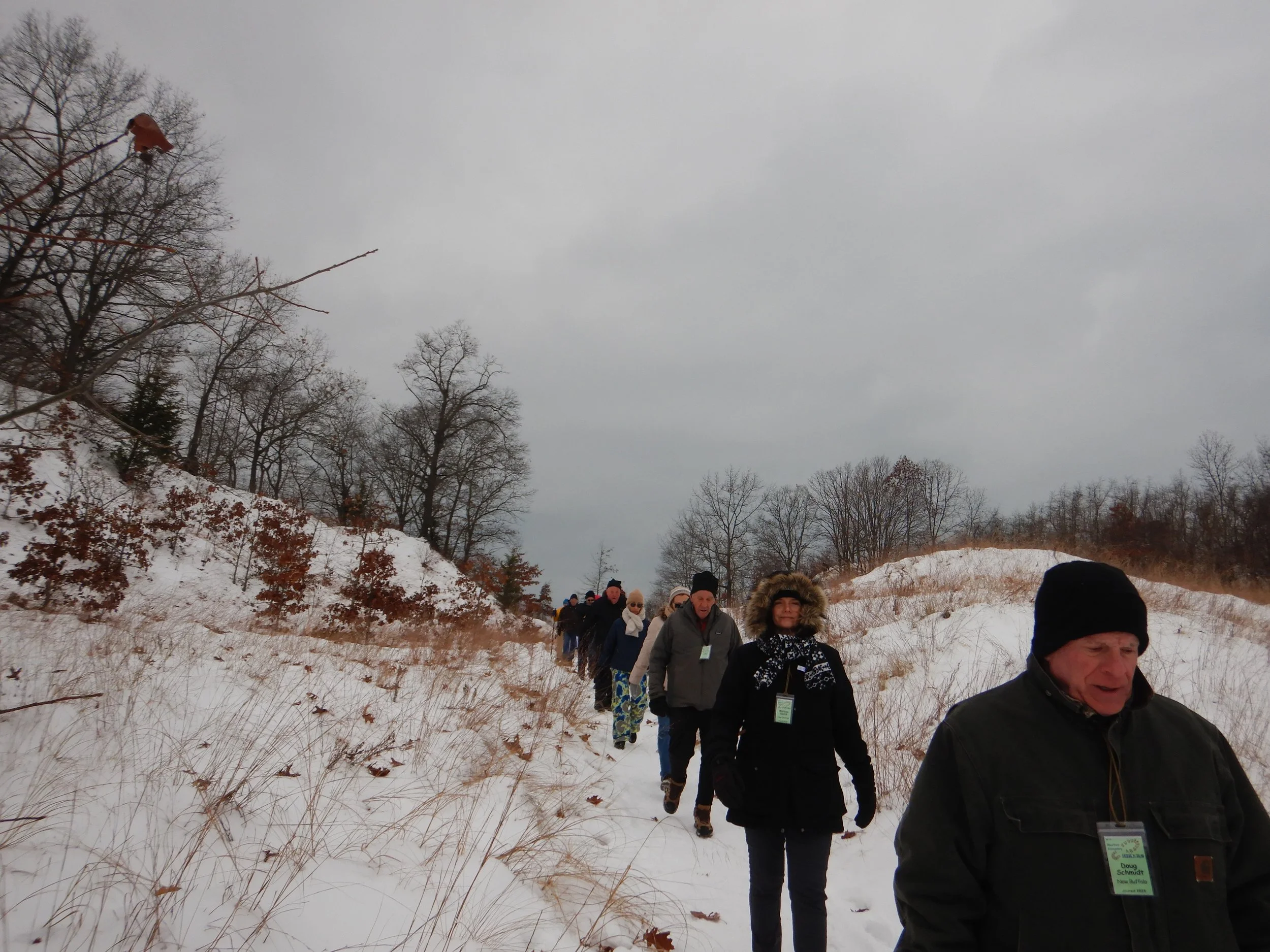
On Saturday, December 6, I headed out to our HCH hike at Grand Mere State Park. I had just returned from sunny Puerto Rico, and the intense cold, my need to spend two hours shoveling the drive, and the loneliness that I felt after being a week without my family made me want to stay home under the covers surrounded by the cat and dog; but I had texted Pat and Mark saying I would do the blog, and I thought Mark Piper had done more than his share. I didn’t know Pat had written the last two blogs. I didn’t know that Mark was not going to take more of his beautiful pictures.
So I read Pat’s advice on layering, affixed the cleats on to my shoes, and parked my car in the large lot. I didn’t bring my phone on the hike. I didn’t take pictures. In my mind, I wanted to see Mark reveling in the beauty of winter at Grand Mere and posting his beautiful images. I want to thank Indre Jurksaitis and Jim Holmes for sending their photos on to me. I have sent some of them on to Pat who, instead of working in partnership with Mark to check for my errors, will stand alone in his generosity and knowledge. I have been a writer nearly all my life, but documenting facts about our environment is a new and challenging thing for me.
Below is part of what I scrawled with my gloved hand. First, and most importantly, winter at Grand Mere is beautiful. As the 18 of us in attendance discovered, we could see so much more now that we weren’t surrounded by lush greenery. We could stand near a bench and see the expansive lake and feel blessed about the diversity of the wildlife, plants, and trees of SW MI. In Grand Mere alone there are rolling prairie plants, a forest of hardwoods, and conifers including white pine and hemlock. Even cacti flourish and flower as part of the leftovers from the Ice Age.
Grand Mere has a moraine to the east, sediment mounds of sand, silt and clay soil that glaciers carried and deposited by moving ice or as a glacial landform left at the margin of ice, and producing a large hill. The glaciers left behind both depressions (kettles) and elevated moraines throught Michigan. Perhaps one can think in terms of holes and hills. However, the three remaining inland lakes at Grand Mere, North, Middle and South Lakes, were formed by sandbar curls, spits, and glacial lake recession. North Lake, Pat explained, has an outlet to Lake Michigan.
Aside from lake formation, Pat gave us tree and wildlife facts. In Grand Mere you can see winter leaves on the oaks and beech trees. The leaves, withered and curled, still protect the buds. They also keep deer from munching on them. Once, Pat explained, bison roamed this area, and once in a great while, lost bears come down from the Upper Peninsula.
We walked uphill over the imprints of other winter hikers. There were slick spots, but the packed-down snow made it not too difficult. Fun facts: that bears don’t go into true hibernation, more like a deep sleep from which they wake every so often. Ground hogs and Indiana bats are true hibernators. Also, like Warren Dunes, Grand Mere has open hunting season. Winter bushes hold food for birds like the ever-present button bush with its many-seeded head and what looked to be cranberries. Yes, commercial harvesting happened at Grand Mere from the 1890s to 1910s, leaving behind unique bog areas with wild cranberries.
Do check the event page. In two weeks HCH will meet at Leonard Wildlife Preserve for level hiking. Also check out the link to Mark Piper’s wonderful photos at <https://www.markpiperphotography.com/>.
Graciously contributed by Miriam Bat-Ami