
Ephemeral
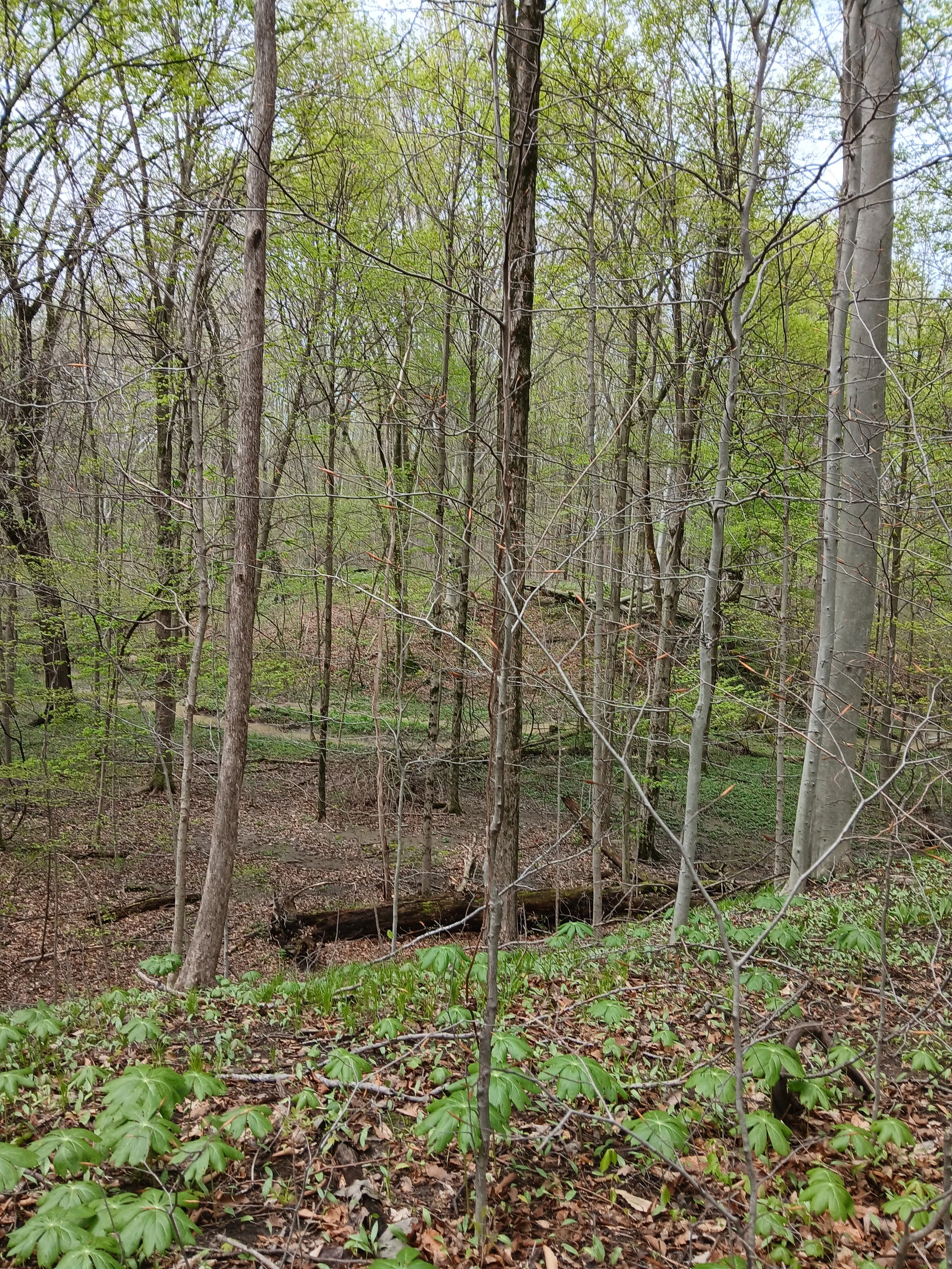
Pic by Member Miriam Bat-Ami
The other day, while walking my aged dog who is suffering from lymphoma, I stared up the length of the trees into the branches where small leaves hung: the tiny limp Japanese maple leaves that would soon uncurl; the sugar maples with small green fists that would unfurl. There was newborn color all around me, and, suddenly, I marveled at the fact that I have seen seventy-five springs, four of them being the early rains of Los Angeles and five being the latter rains of Israel. Sadness nipped on the heels of wonder. I became acutely aware of the fact that my husband missed the last six springs. His absence, I have learned, extends the longest roots inside the core of my existence in April when the world around me is rebirthing itself.
And so, in spring, with a new season unfolding, I write of how ephemeral life itself is. Nowhere does one see that so vividly as when one walks through the Southwest Michigan woods during April. Everything is in constant transition, and everything seems connected by the nature of birth and death that binds us all. I carried this thought with me on our HCH hike April 18th at Sugarwood Forest Preserve where we went in search of early spring ephemerals.
It had rained quite a few days before we all met. Hot eighty-degree weather had been replaced by weather in the early 40s. We came in our winter coats and hats. The fortunate ones of us wore boots for the rich clay ground was covered in puddles, and the muddied trails leading up and down ravines proved challenging. Pat said that we all deserved at least two stickers as we went off-trail and skirted pools that teemed with spring life. Even in April, Michigan weather is ephemeral. We began as a cold bunch of hikers. A half hour into our journey, we were warmed not merely by our exertion but by a steady rise in temperature.
Fourteen of us slid across mud and into leaf-covered dry areas. We spotted trout lilies that grow in colonies. According to the sheets that Pat gave us (“A Guide to Wildflowers of Berrien”) the trout lily’s bulbs are sterile to the seventh year “and then it produces only one leaf and no flowers. A mature plant will grow two leaves and one beautiful yellow flower.” What an act of labor for that one yellow beauty! Because of the heat we noticed a few wilted flowers and many that hadn’t bloomed yet. A yellow flower atop a large bush afforded us another lesson from our fearless leader, this being the difference between ragweed and goldenrod. The latter is sticky and will attach itself to clothes. The former or ragweed floats through the air and is the cause of sneezing and allergies.
Ramp covered the forest floor. Pat crushed a leaf, and many of us bent our noses into it and smelled the freshness of a spring onion. Also called wild leeks, these wild onions are native to eastern North America. They are easily identified by their red-colored stalk and emerge in spring in moist wooded areas. Because they are delicious, something I attest to, sustainable foraging is important. None of us picked the Sugarwood ramp, except for the one crushed leaf. I can say that I salivated over them.
We could not overlook the abundance of mayapples that grew along the sides of the trails. They are so called because of the apple-shaped fruit hidden under drooping umbrella-like leaves. It was too early in the season to see the beautiful helmet looking white flowers. Almost all parts of the mayapple plant including the leaves, stems, and roots contain a toxic compound that can cause severe skin irritation, and the plant is highly poisonous---that is to humans. The Eastern box turtle and the mayapple share a symbiotic relationship. The turtle dispenses its seed after it eats the ripe, lemon-shaped mayapple fruit during mid-summer.
The above germinated another lesson for which I almost named this piece: causation. We all live in a kind of web--humans, animals, plants--and we need each other. Feed the bee toxic bug and weed killer, and we not only lose a marvelous creature, but we lose all the produce that depends upon bee pollination. Mow down the mayapple, and the box turtle, who depends upon the mayapple for food, disappears.
Wooden benches with the letters HCH chiseled into the wood welcome the weary traveler. I sat down on one and learned that Harbor Country Hikers had donated these benches. Pat pointed out ephemerals with his tall walking stick: the many cutleaf toothwort that grow in rich mesic forests that are neither too wet or too dry; a cluster of rue anemone that sheltered itself from the wind on the downside of the ravine, and a few dutchman’s breeches that got their name from the white flowers that resemble miniature upside-down pantaloons. A bunch of marsh marigolds sat in the valley area. On the preserve’s backside were huge old growth maples and beech trees. A pock-holed trunk marked where woodpeckers found food, the large rectangular holes made by Pileated woodpeckers and the smaller circular holes by Downy or Hairy ones. Another lesson. A dead tree lying prone on the ground or standing amongst its living neighbors has not lost its meaning. Clear that tree away, and you lose hiding places where animals shelter in the winter or places where bugs settle and are sought out by insect-eating birds.
We exited the place where a glacier had stalled several millenniums ago. Wildflowers were just beginning to bloom. Here they come later than in other areas because of lake weather. The heat had changed things up a bit, causation of a global nature. In two weeks, we will see the fullness of transient spring and the ephemerals it produces both in Love Creek and Trillium Woodlands Preserve.
Graciously Contributed by Miriam Bat-Ami