
MIRACLE OF MYCELIUM
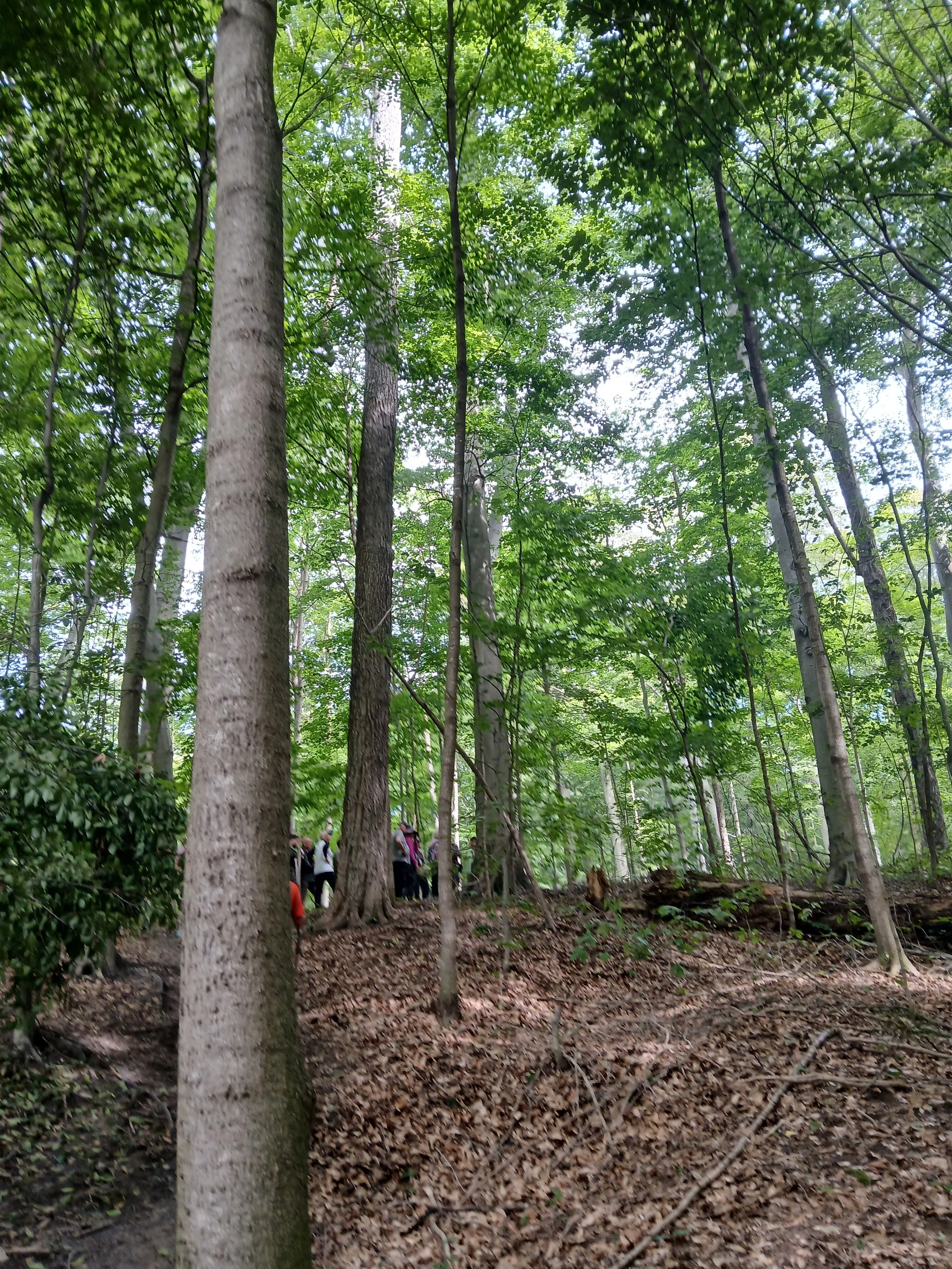
Pic by Author and HCH Member Miriam Bat-Ami
Sometime during our hike through the mucky, hilly, and most beautiful terrain of Warren Woods State Park (WWSP), I turned to a few of the 23 hikers navigating the trail. A storm had passed through. Huge downed old growth beech trees lay across our path. “What,” I asked watching my steps, “should I name the title of my next blog?” (HCH members have grown used to my fumbling about with paper and pen and stopping every so often to take pictures. They will be glad to know I finally bought a clipboard.) I clumsily straddled a tree trunk. “Should it be the Wood Wide Web which alliterates or Fungus Among Us which rhymes?” One fellow liked the first response, so I settled on that until I saw the theme’s title in my email: Miracle of Mycelium. That seemed to say it all.
We could ooh and aah over the magnificence of Michigan forests. Vast expanses of wildflowers could take our breaths away, and we could marvel at the unique qualities of mushrooms that can delight or destroy us, but, beneath our feet, unseen, is the greatest miracle of mycelium, defined in our introduction as “the vast root-like network of fungi…nature’s ultimate recycler and connector.” No person is an island nor are trees: “Sometimes called ‘the wood wide web,’ it [mycelium] acts as an underground information super-highway, allowing trees to share water, sugars, and messages about impending threats.”
Moving through the new growth forest of the 311-acres of WWSP, we listened to Pat who had, at the beginning of this hike, said that his goal is to teach the public about the amazing ecosystems of SW MI forests. On our hikes we would see evergreens that shouldn’t be located here; carnivorous plants that inhabit the Gulf and East coasts, fruit trees that take advantage of our moderated climate, beeches and hemlocks that make for strange and compatible bedfellows. Beneath our feet, under the loamy dirt was a by-product of mycelium, the humongous fungus that allows mother trees to send sugars to saplings. Pat pointed out some mother trees standing tall like preachers surrounded by the thin congregants.
As we walked alongside the Galien River and entered the old growth forest, we marveled at the hugeness of the beech that can live over 400 years and can survive the foolishness of people carving initials on their bark and the intensity of storms although we could see that the beech is little prepared to cope with recent 100 mile an hour winds. We were saddened by the fact that, after extensive logging, only 1% of the Michigan forest remains, and global warming with its storms does nothing to improve survival. We squished our way through the wetland past the pawpaw and tulip trees that love to live along the edges of streams and swamps. Pat mentioned the tamarack, an outsider who has found its place in SW MI forests. While it has needles, it’s not an evergreen and never is ever green but is a deciduous conifer that drops its needles every year. We got fun facts about “snobbish” selectivity. It seems that, in the WWW, the beech networks favor their own kind. Mother trees pump liquid sugars to their saplings, but, if I’m to believe AI, they do “send emergency food and water to sick or dying trees of any species, keeping the whole forest healthy.” There is a lesson to be learned here when we think of global survival.
We looked at the smooth beech bark and the rough maple bark; the maple, growing faster; the beech, living longer and the invisible miraculous mycelium, 68 quadrillion miles of it contained within the earth’s topsoil, described as “the heartbeat for the planet.” Check out SPUN for a visualization of Earth’s underground fungal systems. <https://www.spun.earth/mapping/a-hidden-infrastructure>
For some deeper diving, check out this: <https://www.sciencedaily.com/releases/2026/06/260614011845.htm>
Blog by Member Miriam Bat-Ami (7/11/26)